The Ordinary's Markup Marché: A $625 Jar of La Mer and the $4.9B Question About Prestige Architecture
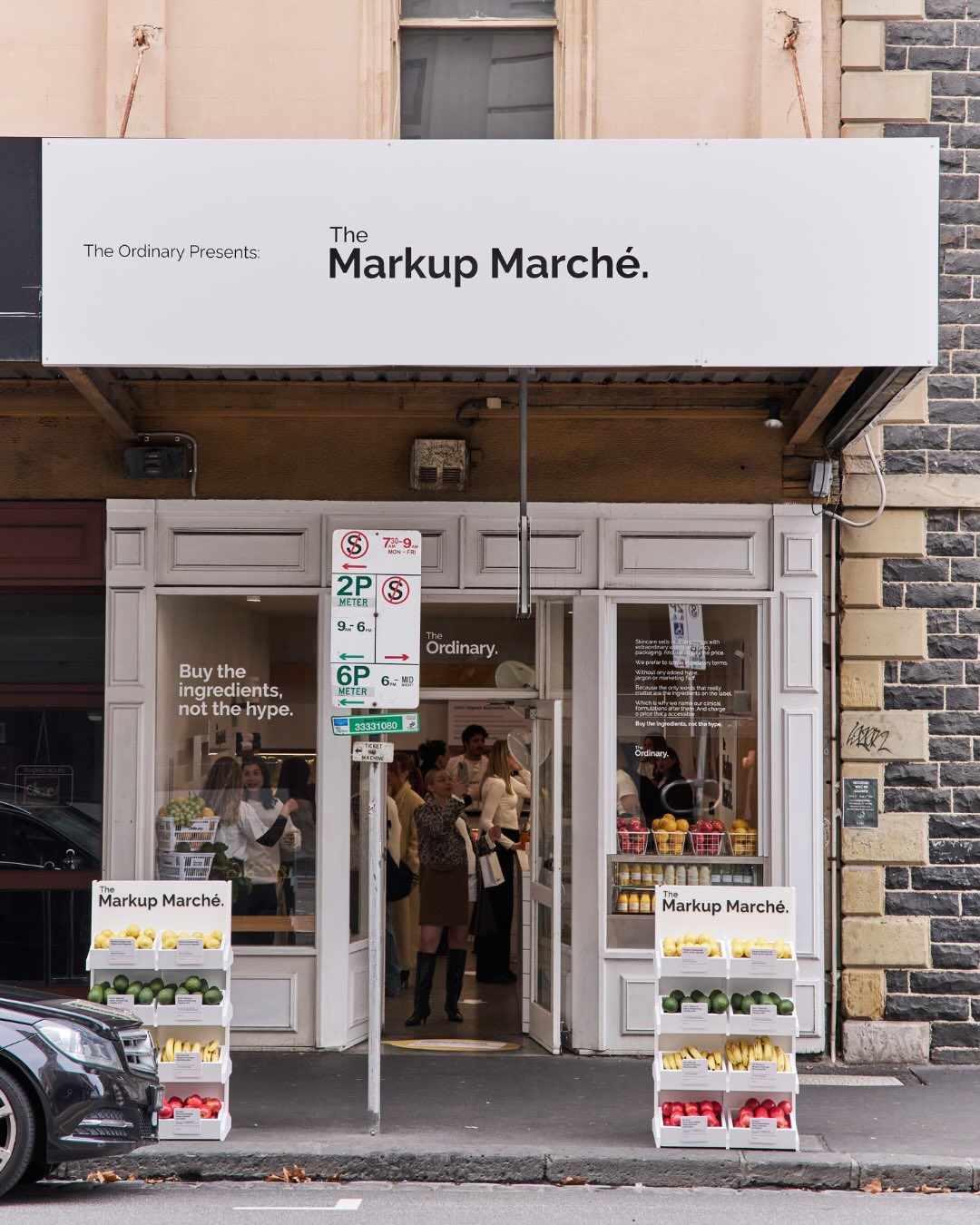
The global prestige skincare market reached $19.6 billion in 2024, yet DECIEM's Markup Marché activation — staging a banana at $175.90 and a coconut at $195.50 across six international cities — may be the most strategically loaded campaign the Estée Lauder Companies have greenlit this cycle. Framed as consumer advocacy, the pop-up is better read as a distribution signal: a subsidiary audibly distancing itself from the parent portfolio's pricing logic at the precise moment ELC navigates a $4.9 billion revenue decline and accelerating masstige encroachment across APAC and GCC channels. The Markup Marché isn't disruption theater. It is a portfolio reset, executed in public.
---
Prestige Positioning Is Under Structural Pressure, Not Just Cultural Pressure
ELC's fiscal 2025 results confirmed what distribution data had already telegraphed: premium department store traffic is contracting, and the consumer cohort that historically absorbed La Mer's $625 Crème de la Mer is bifurcating — either trading into clinical efficacy brands or trading fully into ultra-luxury. The squeezed middle, what the industry increasingly calls the $80–$250 prestige tier, is losing conviction on both ends. A 2025 Circana report noted prestige skincare unit volume declined 3.2% YoY in North America despite nominal dollar growth, indicating price increases, not expanded consumption, are sustaining the top line. That is not a durable architecture.
The La Mer markup calculus — ingredient cost estimated at roughly $50 at today's inflation-adjusted figures against a $625 retail — is not the scandal. The scandal is that the structural argument for that margin is eroding in real time as ingredient transparency tools, dupe-indexing platforms, and AI-assisted formulation comparisons commoditize the information asymmetry that prestige pricing historically depended upon.
For investors evaluating ELC's portfolio rationalization — the company has divested several underperforming brands since 2023 — the DECIEM unit remains a growth outlier with strong CAGR performance in the low-to-mid double digits.
---
DECIEM's Campaign Is a Channel Strategy, Not Just a Brand Statement
Amy Bi, VP at DECIEM, framed the Markup Marché as an efficacy argument. Read through a distribution lens, it is a retail positioning play. The Ordinary is currently stocked across Sephora, ASOS, Shoppers Drug Mart, and direct-to-consumer globally — a masstige distribution architecture that requires the brand to continuously justify its value proposition against both drugstore adjacency and prestige aspiration. Anti-markup messaging accomplishes two channel objectives simultaneously: it differentiates The Ordinary from ELC's upper-tier brands within the same retail environment, and it converts dupe-culture consumers — who arrive skeptical of margin — into advocates before they defect to private-label alternatives.
This is premiumization logic inverted. Where most brands engineer upward price drift to capture margin, The Ordinary is engineering downward trust accumulation to capture volume. In a category where customer acquisition costs have risen 34% since 2021 per industry benchmarks, earned media through provocateur campaigns functions as a viable CAC alternative.
---
In a category where customer acquisition costs have risen 34% since 2021 per industry benchmarks, earned media through provocateur campaigns functions as a viable CAC alternative.
The M&A Overhang Changes the Risk Calculus Entirely
The campaign carries risk that independent brands executing similar messaging would not absorb. The Ordinary operates inside ELC's majority-owned DECIEM structure — a fact that informed observers in MENA and APAC trade circles are unlikely to overlook. Anti-markup credibility has a shelf life measured against two variables: parent company pricing practices and The Ordinary's own price ladder trajectory. DECIEM has incrementally raised The Ordinary's retail prices since 2021, with select SKUs increasing 15–22% over the period. If that trend continues, Markup Marché will read retroactively as positioning arbitrage rather than principled differentiation.
For investors evaluating ELC's portfolio rationalization — the company has divested several underperforming brands since 2023 — the DECIEM unit remains a growth outlier with strong CAGR performance in the low-to-mid double digits. The strategic question is whether anti-establishment messaging can be sustained at scale under a $14 billion parent without triggering credibility decay among the exact consumer cohort it is designed to activate.
---
The Brands Watching This Most Carefully Are Not ELC's
The Markup Marché's most consequential audience is not The Ordinary's consumer base. It is the mid-market brand managers and retail buyers recalibrating prestige positioning in an environment where price transparency is permanent infrastructure, not a trend cycle. Brands operating in the $50–$150 skincare corridor — where masstige and accessible prestige compete directly — face the sharpest version of the question this campaign raises: what is the defensible margin on a formulation that a well-funded dupe manufacturer can replicate within 18 months of launch?
The answer increasingly involves distribution exclusivity, clinical substantiation depth, and supply chain differentiation — not markup obfuscation. The brands that will hold margin in 2027 are building proprietary delivery systems, not heritage narratives. The Ordinary understands this. The question is whether the rest of the prestige tier does.