Gourmand Fragrance Commands $5.6M in Monthly Amazon Revenue: What the Category's Distribution Architecture Reveals About Prestige Repositioning

Gourmand fragrance has quietly become one of the most strategically revealing segments in the North American beauty market. On Amazon alone, the category accounts for approximately 15.5 percent of total fragrance revenue, generating an estimated $5.6 million across the top 10 SKUs in a single month, per Market Defense intelligence. That figure is not simply a seasonal gifting anomaly. It is a structural signal about where distribution architecture is shifting, which brand portfolios are built for digital scalability, and which prestige players are losing channel relevance faster than their marketing budgets can compensate.
Mist Format Is Doing the Strategic Heavy Lifting
Body and hair mists account for roughly 40 percent of gourmand revenue on Amazon, a format distribution ratio that carries significant implications for portfolio planning. Sol de Janeiro holds four of the top 10 positions through its Cheirosa franchise alone, with Cheirosa 62, 39, 76, and 40 generating a combined estimated $2.65 million in monthly revenue on a single retailer. Chief Engagement Officer Vanessa Kuykendall of Market Defense frames the mechanism precisely: gourmand fragrance on Amazon operates as a gifting engine, with sales rank improving two to seven times between September and the November-December peak window.
The mist format's dominance reflects a calculated masstige positioning that Sol de Janeiro, majority-acquired by L'Occitane Group in 2023, has executed with remarkable channel discipline. Price points between $22 and $38 clear the Amazon gifting threshold without triggering the prestige dissonance that typically erodes full-line EDP performance in marketplace environments. For brand strategists evaluating digital distribution architecture, the Cheirosa franchise is the current benchmark case for format-led premiumization without sacrificing velocity.
Challenger Brands Are Extracting Disproportionate Share
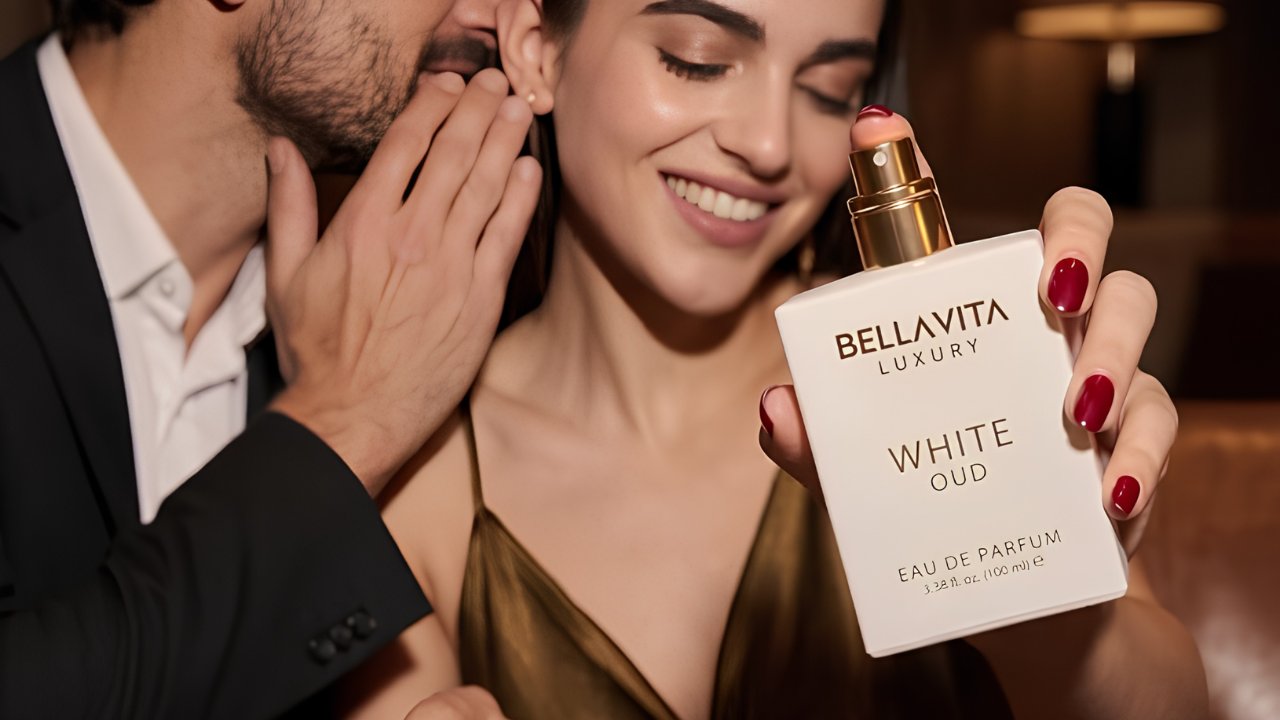
Bellavita's Honey Oud Eau de Parfum registered a 235 percent year-over-year sales increase to claim the top revenue position at an estimated $1.25 million for the month, outperforming every established house in the ranking. That performance demands context. Bellavita operates without the wholesale infrastructure of an Armani or Azzaro, which means its Amazon revenue represents a higher margin concentration and a more direct read on organic consumer demand rather than retailer push mechanics.

DedCool and Phlur, both venture-backed independents with minimal brick-and-mortar footprints, each generated an estimated $420,000 in the same window. Their presence in a top-10 list alongside Giorgio Armani Beauty is not incidental. It reflects a structural shift in fragrance discovery architecture, where algorithm-driven placement has partially displaced the counter-and-tester model that historically protected established houses. For M&A analysts tracking acqui-hire targets in the indie fragrance space, DedCool and Phlur's Amazon traction is precisely the kind of channel-validated proof of concept that precedes strategic consolidation conversations.
Armani and Azzaro Signal the Limits of Legacy Positioning
Armani Beauty's Stronger With You Intensely posted 76 percent sales growth to reach an estimated $550,000, and Azzaro's The Most Wanted Eau de Parfum Intense contributed $470,000, both respectable figures. But the relative positioning of these titles, sitting fifth and sixth behind three Sol de Janeiro mists and a challenger EDP, reflects a tension that fragrance divisions inside large conglomerates are navigating with increasing urgency. Prestige positioning built around counter distribution and department store adjacency does not translate automatically into Amazon velocity. The search and recommendation logic on marketplace platforms rewards recency, review volume, and price-to-format optimization rather than heritage equity.
For portfolio managers at Coty, L'Oreal, or Puig evaluating their fragrance distribution architecture, the lesson is direct: channel-native product development requires format decisions upstream of launch, not retrofit digital strategies applied post-commercialization.
Q4 Will Stress-Test Every Brand's Gifting Infrastructure
Market Defense data indicates that leading gourmand SKUs see sales rank improvements of up to seven times between September and peak gifting weeks, a compression window that rewards brands with fulfillment infrastructure, review depth, and sponsored placement budgets calibrated specifically for Q4. The brands positioned to capture disproportionate share through December are not necessarily those with the strongest olfactive reputations. They are the ones whose distribution architecture, inventory positioning, and digital shelf strategy have been built around the gifting occasion as a primary commercial event. As the gourmand category continues its compound growth trajectory within the broader $9.3 billion U.S. fragrance market, the strategic question for every portfolio owner is not whether to participate, but whether their channel infrastructure is built to win the moment when the rank multiplier actually arrives.
This article references and builds on original reporting by Kaleigh Werner for WWD. Read the original piece here: https://wwd.com/beauty-industry-news/fragrance/top-gourmand-scents-fall-amazon-1239347796/. BeautyScale is a commercial agency; our editorial notes are commentary on industry reporting.
Martin Jacob
Beauty market analyst covering trends, brands, and distribution shifts.