Ayurvedic Prestige Pricing: LAVANAĒ's $125 Threshold Resets Western Skincare Hierarchy

India's beauty and personal care market is on track to reach $34 billion by 2028, according to the India Brand Equity Foundation, and global conglomerates are repositioning accordingly. L'Oréal's acquisition of an Innovist majority stake, The Estée Lauder Companies' full consolidation of Forest Essentials, and Puig's majority position in Kama Ayurveda collectively signal that Ayurvedic beauty is no longer a niche category hedge. It is a strategic asset class. Into this accelerating landscape, LAVANAĒ enters with a two-SKU debut priced at $105 and $125, a deliberately narrow assortment, and a founder whose background in technical systems architecture at Amazon is shaping the brand's category thesis more than its ingredient list.
A Portfolio Logic Built Before the Catalog Exists
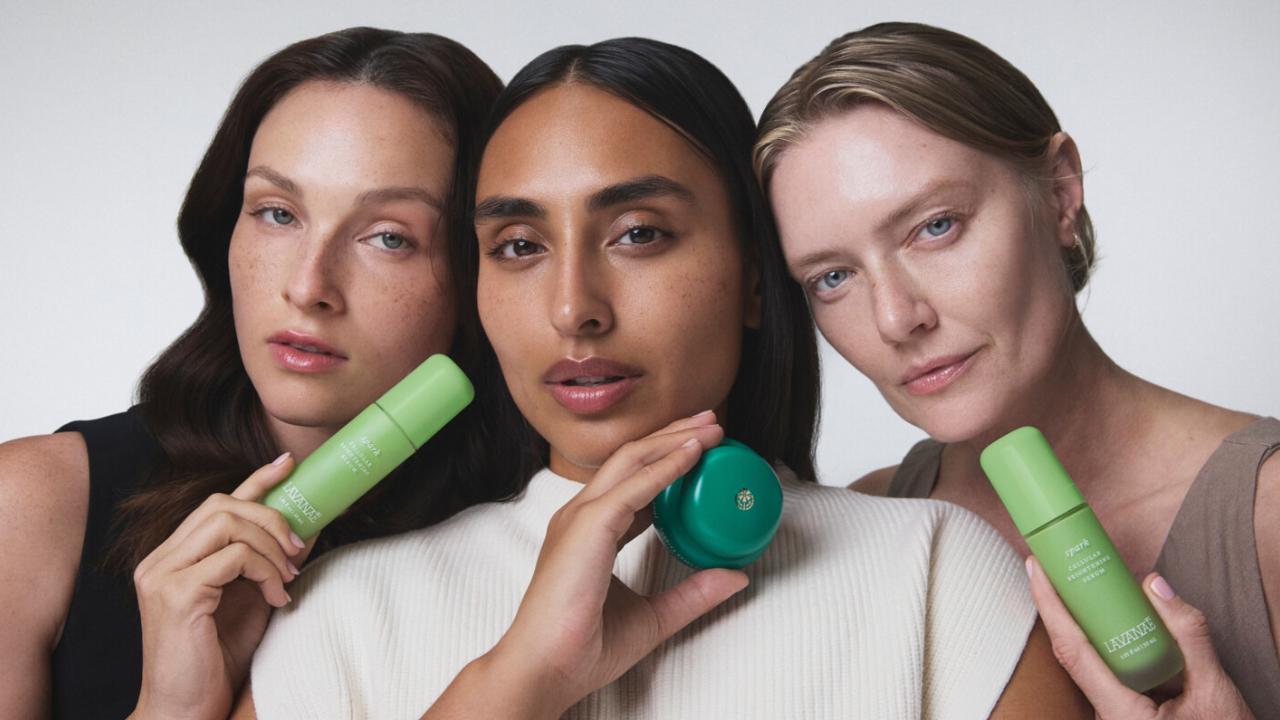
LAVANAĒ founder Aprajita Lavania formulated the brand's debut two products over two years alongside board-certified dermatologist Dr. Shikha Shah. The $125 Spark Cellular Brightening Serum and $105 Seal Barrier Reset Cream are not positioned as standalone SKUs. Each targets four to five of seven interconnected skin pathways Lavania has mapped, and together the two products address all seven. This is systems architecture applied to portfolio design, a methodology rarely executed with this degree of intentionality at launch. For investors and category buyers evaluating early-stage prestige brands, that coherence carries weight because it signals a founder who is building a scalable product logic rather than iterating reactively.
The proprietary DESC-6 complex, blending Ayurvedic botanicals with clinically validated actives, functions as the portfolio's connective tissue. That kind of formulation architecture creates defensibility. Brands that anchor each product to a unifying proprietary system earn cleaner brand equity and are substantially easier to position in retail environments where shelf storytelling matters.
A founder who refuses to extend the assortment without systemic justification, who prices at the top of the Ayurvedic comp set, and who delays retail entry to protect data integrity is building toward an asset that acquirers will recognize.
Distribution Architecture: The DTC Discipline That Precedes Retail
LAVANAĒ is launching direct-to-consumer with no immediate retail ambitions, an increasingly deliberate strategy among prestige indie founders who watched earlier Ayurvedic brands scale distribution before they scaled data. Lavania has stated publicly that she intends to gather consumer feedback and purchase behavior data before entering retail. This positions LAVANAĒ closer to the Augustinus Bader playbook than the indē wild one. IndE wild, the Diipa Büller-Khosla-founded brand, became the first homegrown Indian beauty brand at Sephora U.S. in March 2026, rolling out to 178 doors. The velocity data from that expansion will be closely watched by retailers evaluating how Ayurvedic prestige performs in a Western door environment.
The DTC-first posture also gives LAVANAĒ pricing integrity. At $125 for 30 ml, the Spark Serum sits in a price band shared by Tatcha, Drunk Elephant, and select La Mer SKUs. Entering retail prematurely risks promotional pressure that erodes prestige positioning before it has time to calcify in consumer perception.

Prestige Positioning in a Masstige-Saturated Category
The broader Ayurvedic beauty segment in the U.S. has historically clustered in the masstige corridor, with brands like Sahajan at Sephora Canada and Urban Veda at Ulta anchoring the category in the $30 to $70 price range. Squigs, Soma Ayurvedic, and Wild Grace have built loyal bases at similar price points. LAVANAĒ's $105 to $125 opening price architecture is a deliberate portfolio reset, staking out a prestige lane that few Ayurvedic brands have attempted with clinical validation at the foundation.
LAVANAĒ is launching direct-to-consumer with no immediate retail ambitions, an increasingly deliberate strategy among prestige indie founders who watched earlier Ayurvedic brands scale distribution before they scaled data.
Ranavat, founded by engineer-turned-entrepreneur Michelle Ranavat, is the most credible comparator in this prestige positioning exercise, with select serums reaching $98. LAVANAĒ's debut prices clear that threshold and signal an intent to compete on ingredient investment and clinical rigor rather than heritage storytelling alone.
The M&A Lens: Why LAVANAĒ's Timing Is Strategically Legible
The strategic consolidation of Ayurvedic and India-origin brands by L'Oréal, Estée Lauder Companies, and Puig creates a recognizable acquisition framework. Brands with defensible IP, clinical substantiation, a coherent portfolio architecture, and clean prestige positioning are the most acquirable assets in this category cycle. LAVANAĒ checks each of those criteria at inception, which is either a coincidence of founder discipline or a calculated entry thesis. Given Lavania's product management background, the latter is the more probable read.
The U.S. market's premiumization trend shows no structural reversal. NPD Group data consistently shows prestige skincare outperforming mass in dollar growth even when unit volumes compress. A founder who refuses to extend the assortment without systemic justification, who prices at the top of the Ayurvedic comp set, and who delays retail entry to protect data integrity is building toward an asset that acquirers will recognize. The question is not whether LAVANAĒ fits the current M&A appetite in this category. The question is how long Lavania intends to build before that conversation becomes relevant.
This article references and builds on original reporting by BI Staff for Beauty Independent. Read the original piece here: https://www.beautyindependent.com/former-amazon-product-manager-aprajita-lavania-lavanae-ayurvedas-systems-thinking-to-luxury-skincare/. BeautyScale is a commercial agency; our editorial notes are commentary on industry reporting.
Rami Al Ariss
Beauty market analyst covering trends, brands, and distribution shifts.